Saturday, June 29, 2019

Toy Story 4: Purpose Lost and Found


No lesser luminary than Socrates once exclaimed, "The unexamined life is not worth living." Socrates, meet Woody.

Kids who grew up with the Toy Story gang 24 years ago now (gasp!) have children of their own. Roles change, some people outgrow toys - and some of us don't. People adjust to new chapters in their lives - and as it happens, so do some toys.

Disney's Toy Story franchise has remained wildly popular across age groups, serving as a touchstone for play, adventure, and the importance of friendship. But the films also wrestle with existential themes of self, purpose, reality, abandonment, belonging and loss. It can be a heady and emotional mix, but it's that depth of feeling that has endeared the films to more than one generation of children (and their parents), beyond the assembly line plot mechanics of so many other films. Like Finding Dory, there's a lot going on beyond the fun and games.

In Toy Story 2, Woody (Tom Hanks) faced awareness that he wasn't just a toy, he was part of a beloved TV franchise, with companions he'd utterly forgotten. In 3, Buzz, Woody (Tim Allen) and the gang face the sobering realization that their "kid" - Andy - is growing up, and their circumstances need to change, finding renewal with a new, younger child, Bonnie, where they've continued on in the interim direct-to-video shorts Toy Story of Terror and Toy Story That Time Forgot, their plaything family expanding as they joined Bonnie's existing toys.

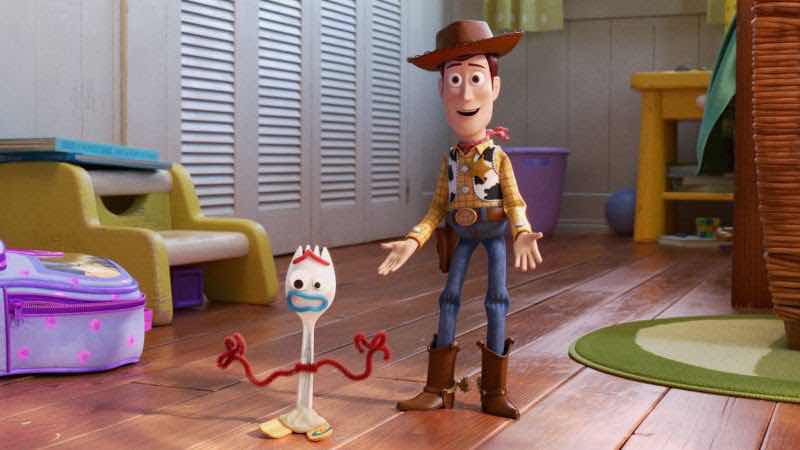
In Toy Story 4, Woody looks still deeper at his sense of self, of belonging and his place in the world - and the toy tribe expands even more. Bonnie (Madeline McGraw) is playing with Woody less and less, and has palpable anxiety at the prospect of going to kindergarten. Her savior? Her own imagination, and an arts and crafts amalgam of pipe cleaners and googly eyes she calls "Forky." Forky (Tony Hale) is stunned to discover he's not only come to life, but that he's now become Bonnie's favorite, the vessel for all her emotional dependence and need for security. He's also surreal and cute, and like Star Wars’ BB-8, a genuinely successful creation that actually transcends the deliberate genesis of a focused team of designers. Kids love Forky - I know mine does.

Before kindergarten begin in earnest, Bonnie's parents decide to go on a road trip in a rental RV, so the toys hit the road, some becoming lost - some literally, some figuratively. Toy Story fans have wondered why Bo Peep (Annie Potts) wasn't in the third outing, and in an exciting prologue, we learn why. Stranded in a small town with a particularly Twilight Zone-feeling antique shop, Woody and Bo are reunited, and Woody tangles with devilish dolly Gabby Gabby (Christina Hendricks) and her gaggle of ventriloquist dummy henchmen. The theme of an individual's voice is prominent throughout the story. Buzz diligently works the suggestion of listening to his "inner voice," while another character is threatened with the theft of their actual voice box. Chew on that!

In addition to Forky and Gabby Gabby, other new characters include Evel Knievelesque Duke Caboom (Keanu Reeves), "Canada's greatest stuntman!" and the hilarious carnival prize-pair of Ducky and Bunny (Keegan-Michael Key and Jordan Peele), all of whom do a great job of stealing scenes at every opportunity.

Potts is fantastic as Bo Peep, who's become an empowered staff-wielding she-warrior who'd be right at home in either Middle Earth or Fury Road. Her voice work is tremendously varied and full of emotional character moments. She's wonderful, as is Hendricks. In fact, there are so many new characters in Toy Story 4 who take center stage, that you find yourself missing time with the original gang and wishing there was more of them. I really wanted more of Jessie (Joan Cusack) and Mr. Pricklepants (Timothy Dalton)! But evolve we must. We spend a lot of time in that antique shop (I've never seen dust so convincingly rendered!), and Woody spends a lot of time navel-gazing (Sorry, Socrates). When climactic escapes occur and venues change, it feels downright liberating. The film is full of emotion, and I found it to be surprisingly more poignant/serious than I expected, and on a first viewing, less outright hilarious than the previous films.

It may take another viewing (or two, if my 10-year-old has any say in the matter) before I completely warm up to this new, different Toy Story. It definitely feels a bit less familiar. Pixar never phones it in, and they have a remarkable ability to depict characters and situations that kids absolutely connect with and lastingly embrace. If anything, Toy Story 4 surprised me with some its choices, though that's likely a good thing. Resilience, loyalty, courage, self-sacrifice and the necessity of change aren't what you might expect from a kids' movie, and it's refreshing to see these values at work here. I suspect my fondness for this movie is only going to increase, especially when it hits the cycle of near-perpetual home video replay constancy in my not too distant future.

Forky fans can also look forward to Forky Asks a Question, debuting when Disney+ begins streaming this November. In the meantime, definitely see Toy Story 4, easily the best family film in theaters, and a visually remarkable, emotionally moving treat everyone can share together. 


Friday, June 7, 2019

Plodzilla: King of the Monsters


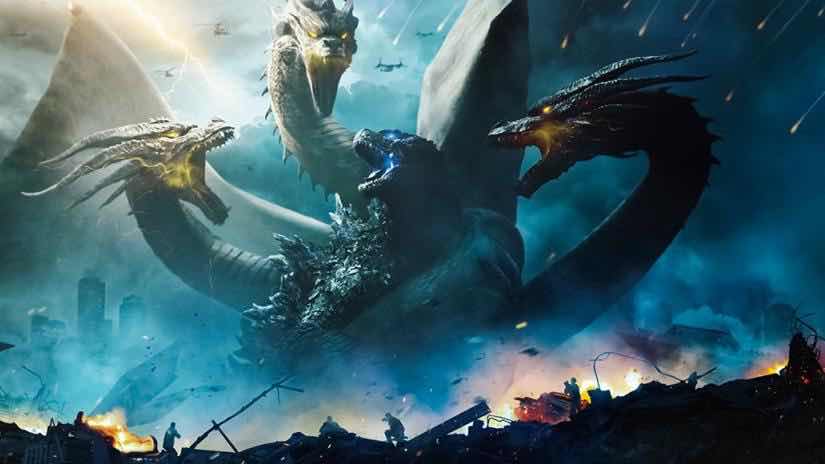
Oh, how I wanted this movie to succeed. After the overall disappointment of 2014’s Godzilla, once again, I let a well-cut trailer fuel my optimism, and was excited for a colossal buffet of mega-monsters, with Rodan, Mothra and King Ghidorah joining the mix to wreak havoc on buildings and citizens alike.

Directed by Michael Dougherty (Trick ‘r Treat, Krampus), Godzilla: King of the Monsters is essentially two movies: one, about 40 minutes of pretty excellent effects work showcasing Godzilla and the classic bestiary of behemoths. The monsters are nicely rendered and pretty cool. The other movie, sadly, is the one with the actors in it – a life-sucking assortment of poorly drawn characters that have been handed some of the worst dialogue in recent memory.

Vera Farminga and Kyle Chandler are estranged married scientists, both of whom have a connection to Monarch, the secret organization that has been monitoring the world’s reemerging kaiju. They have a daughter – Stranger Things’ Millie Bobby Brown, who vaguely yearns for them to reassemble as a family. These are all good actors, who tackle their roles with conviction, determined to bring intensity to every scene. Much wide-eyed Jurassic Park open-mouthed gazing ensues. Wind and rain lashes at them, as they lean into the green screens. Poor Brown has virtually no dialogue but screams like she’s on fire, or evoking Drew Barrymore’s Scream phase. Charles Dance (the late Tywin Lannister) is some kind of villain, glowering and causing havoc.

The monsters emerge at various global locations, with a massive stealth bomber the only means to quickly cross huge distances between events. The timeline and logistics are beyond confusing. We’re in China, then suddenly Antarctica, then Boston. How did we get here? How did we get here so fast?! Ludicrous occurrences take place involving nuclear weapons, like when a nuke’s shockwave hurls an intact submarine popping up out of the ocean – or when characters squint against the proximity of a blast like it’s a dust storm.

Avengers: Endgame was a three-hour movie that felt like forty minutes. King of the Monsters is a two-hour and twelve-minute movie that feels like seven and a half hours. There are some exciting sequences to be sure – but if those scenes were oxygen, you’d suffocate by the time the film lurches to an end. Mothra has been nicely redesigned, looking way more believable than its cinematic forbearer. King Ghidorah is fantastic, and genuinely freaky and terrifying. The monster scenes are well executed, they’re just not particularly inventive or awe-inspiring. There’s a curious detachment to the destruction that numbs the audience. The blame has to go to Dougherty and co-writer Zach Shields, who went with a script that feels lifeless and dialogue that sounds like reading a weather report.

Jordan Vogt-Roberts’ Kong: Skull Island was deliriously more entertaining and fun. We’re getting another chapter in this “shared universe” saga in 2020, with Adam Wingard’s Godzilla vs. Kong. Let’s hope that next installment’s more Skull Island than Godzilla, at this point. It’s clear that director Dougherty has great affection for Ghidorah, Godzilla and the rest. It just seems that he didn’t know how to craft a satisfying story around that reverence, which is a shame, because these actors – and the audience – deserved much better.

Monday, June 3, 2019

“Safe passage to us all.” Deadwood: The Movie - Justice Served


“What a grand surprise after such a piece of time.” 


After three seasons, when HBO’s Deadwood ceased production back in 2006, it definitely left fans feeling like there was more to be said – more story left to be told.


In the 13 years since the show left us, Deadwood’s enthusiasts have only grown more fond of this uniquely profane, Shakespearean Western. We’d been hearing for some time that HBO was considering getting the band back together, of reuniting a cast that had been scattered for more than a decade. It seemed like an unlikely challenge in logistics, at best.


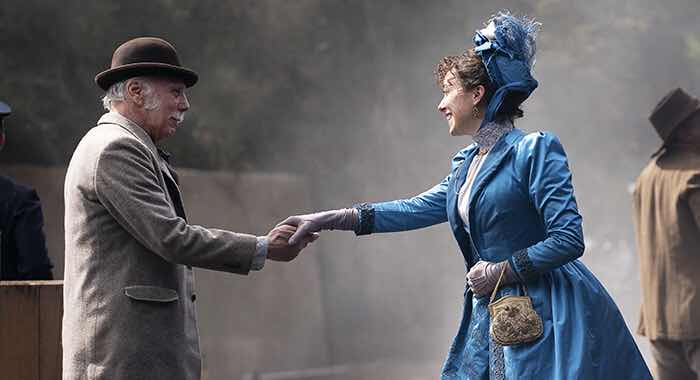
But sometimes pipe dreams can make themselves tangible, and creator/screenwriter David Milch has pulled off a wildly successful closing chapter for this cultish collection of characters and the barely-tamed town they call home. There’s a lot that’s amazing about Deadwood: The Movie, one of the best things being how openly it acknowledges that time has moved on, leaving its mark on both landscape and denizens alike. A decade has passed, and it’s 1889, with South Dakota having at last been granted Statehood. In a vivid opening shot, a relentless locomotive bursts out of tunnel, bearing down on the town like the inexorable approach of change – of the future. Sprouting telephone poles are now the investment crop of the day, making it that much harder for Deadwood to keep itself apart from the outside world’s encroachment. The train’s arrival marks the return of the town’s most ruthless adversary, George Hearst (Gerald McRaney) – now a California senator and a determined backer of the progress knocking on Deadwood’s door. 


There’s a lot more gray on view since we last saw these characters – some of whom are now downright old. Charlie Utter (Dayton Callie) stands as a distinguished reminder of a more gracious past, when he greets returning Alma Ellsworth (Molly Parker) at the train station. Lawman Seth Bullock (Timothy Olyphant) – now a U.S. Marshal – is older, more distinguished, still an active family man. Saloon owner Al Swearengen’s (Ian McShane) health is in decline, his liver failing after long years of strain. Hearst’s return in an even more elevated position of power is the catalyst that sets things in motion.


The film makes deft use of flashbacks, but I would highly recommend revisiting the series’ finale (3.12, Tell Him Something Pretty), as an extremely helpful refresher on where things left off.

Deadwood was always a show that emphasized character over plot, and that prominence continues here, though the bittersweet story Milch has crafted serves as a more than fitting return – and sendoff – to these characters. This is a show that loves actors, and the cast seems to really be savoring the miraculous opportunity to be back working together after such an absence. In addition to Callie, McRaney and the other cast veterans, Paula Malcomson and John Hawkes are superb as Trixie and Sol Star, who are still together and about to bring a child into their lives. Malcomson’s recklessly impulsive balcony harangue of Hearst is truly something to behold. Kim Dickens, Brad Dourif, Franklyn, Ajaye  and Anna Gunn, are among the many familiar faces Deadwood welcomes back. Robin Weigert is spectacular as Calamity Jane, but the great William Sanderson is disheveled sublimity as E.B. Farnum, Deadwood’s “titular” mayor, exasperating Hearst with obsequious apologies for “wanton leakage.”


If events conspire to rob Deadwood of its symbolic soul, the characters aren’t going down without a fight. Olyphant’s years on Justified have served him well, and perhaps no other actor can so immediately inspire fear of imminent reprisal just by walking towards a building. “My job ain’t to follow the law, Al. My job is to interpret it, then enforce it accordingly.” Massive kudos to director Daniel Minahan (a Deadwood veteran, along with Game of Thrones), who does a magnificent job of reconjuring Deadwood the town, as well as crafting pitch perfect moments for all the cast to shine. Milch has a wonderfully focused and economical screenplay that never drags and never feels rushed. The script is equal parts elegy and suspense, including an auction that had me with me on the edge of my seat. Despite the insistent arrival of electricity, it feels like the lights of Deadwood are starting to grow dim – in the most personal of ways. When Al Swearengen finds himself defending his mental state to Doc Cochran – “Mistaking Friday for Tuesday – well, secure my burial plot.” – we can’t forget that creator Milch was himself diagnosed with Alzheimer’s just before production got underway.


Make no mistake – Deadwood: The Movie is a small miracle. It stands as a moving, compelling example of what can happen when a community of artists makes an opportunity to serve justice to story and characters they all hold dear. Very highly recommended. 


Saturday, May 25, 2019

Parasite edges Tarantino to win Cannes


Despite its six-minute standing ovation, Quentin Tarantino’s Once Upon a Time in Hollywood came up empty handed at this year’s Cannes Film Festival, with the coveted Palme d'Or going to Korean director Bong Joon-ho (Snowpiercer), for Parasite, with Mati Diop’s Atlantics winning the runner-up Grand Prix award.

Tarantino had hoped to nab the Palme d'Or, the same trophy he won 25 years ago for Pulp Fiction. Once Upon a Time in Hollywood was extremely well received, but the dark comedy Parasite elicited flat-out raves, with jury president Alejandro González Iñárritu calling the Palme d'Or decision,"unanimous."

Wednesday, May 22, 2019

Sifting through the ashes: Game of Thrones series finale


By now you’re either so tired of reading about these final episodes of Game of Thrones that you’re ready to hurl yourself from an open window, or you’re just so desperate for validation of your own reactions that you’re willing to read anything - even this! 


We’ve been obsessed with this show since 2011, and it’s only natural that after such a long, intense ride - that when the breakup finally happens, there’s confusion, there’s accusation, betrayal...and a fair portion of grief. So how did I react to all this? 


Things started to go south for me this season with Brienne and Jaime. His decision to leave her and go back to Cersei – and more than that, Brienne’s weepy reaction to his leaving, essentially turning her into a male-dependent rom-com character. This only galled me all the more on Sunday, where she dutifully fills in his pages in The Book of Brothers. This undermined her character so much, depicting her as a mopey and delusional torch-bearer. Oh, what I would have rather seen her write about him! Or better yet, rip his page right out of the book and burn it to ashes, which would then settle among the countless other ashes that fill the remains of King’s Landing. 


I would have rather had it that Jaime came back to put an end to Cersei and try to kill her himself. Essentially seeing her as the vampire that she is, who’s ruined his life, and that the only way he can ever be free would be to put an end to her. Because the entire doomed lovers rubble burial for those two was beyond lame. Cersei’s last great act of evil was ordering the execution of Missandei, which was a heck of a moment, one of the best of the season (despite the improbability of her being captured by them in the first place – but then improbability and convenience have ruled these last few episodes more than anything else). Cersei is an epic character, and she cried out for an epic demise. Some final last stand act of malice, that needed to surpass her destruction of the Great Sept at the end of season 6. What she got instead was a totally anticlimactic and unsatisfying demise that left the audience wanting mightily. Then Tyrion so easily finding their bodies (huge face-palm). They were in the subterranean basement of the Red Keep when colossal tons of brick and stone came crashing down on them. Yet somehow their corpses magically floated up to the top of said tonnage, so Tyrion only had to remove a few stray bricks to reveal them?! Come ON….!


I have to ask myself what the point of this story was all along, and how crazy it felt to dispatch the Night King and his legions so early in the season. Because the only theme I can see is “the leopard can’t change his spots” – that your fate is sealed and you can never escape it. Jaime was fated to love Cersei no matter what. Jon Snow is fated to spill his guts and blurt out the truth no matter what. Daenerys is fated to succumb to her family’s curse of fiery madness and rage no matter what – despite seven previous seasons positioning her to be a liberating force for good. For me, she’s emblematic of those plot decisions that are just so vexing. We’ve invested ourselves in her so heavily for so long, to have her just freak out and commit mass genocide is a complete betrayal. It wasn’t “Red Wedding” clever, or “Stabbing Littlefinger” clever – it felt like a cheat. An act of duplicity that felt like a slap in the face to everyone who’s been cheering her on to victory, and symptomatic of how the writing has undermined most of the female characters on the show this season. From Sansa’s jaw-dropper to the Hound that her abuse helped build her character, to Missandei being put back in chains, to Cersei’s narrative lack of climactic action – ending with Daenerys being forced to fulfill the eye-rolling trope of all powerful women being too emotional to lead, therefore they must be insane. That women can’t be trusted with authority because they feel their emotions too much. Khaleesi of the Great Grass Sea, The Unburnt, Breaker of Feminism.


But if you’re going to turn our deliverer into an angel of the apocalypse, the penultimate episode The Bells was without a doubt tremendously well executed. If you’re going to obliterate King’s Landing, the director and effects teams involved depicted it in amazing fashion. We finally got Cleganebowl, which was visceral and exciting, yet somehow nowhere near as intense as Brienne’s big fight with the Hound, or the Mountain’s clash with Oberyn Martell, both from the exceptional season 4. Having these two brothers finally have at each other after years of audience expectation is at least one example where the writers made sure to deliver the goods. In contrast, the fight between Jaime and Urine – I mean Euron – Greyjoy was disposable and perfunctory.


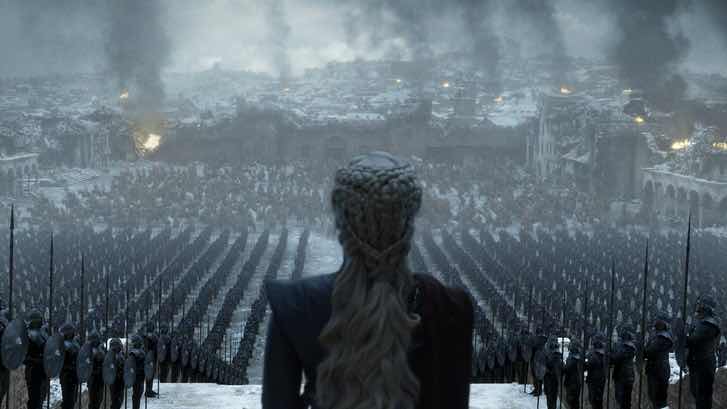
What we’re given is that Daenerys gives in to the dark side – well and fully. In the finale, the Queen of Ashes is depicted in Third Reich conqueror imagery, her legions arrayed before her in perfect symmetry, a massive red Targaryen banner draped across the ruins of stone. In a phenomenal bit of shot composition, her last dragon spreads its wings behind her, a final symbol that this Queen is fully possessed by the supernatural shadow of her family’s predisposition to fiery wrath.


The last big moment of the series is Jon Snow’s murder of Daenerys, abetted by a hefty dose of narrative convenience. The Queen has gone to survey the Iron Throne, when Jon finds her – alone. There is simply no way in conceivable reality that Daenerys would ever, ever be alone and vulnerable to attack like this. She’d be surrounded by Unsullied soldiers wherever she went. But she is, with Drogon lurking outside evidently meant to be sufficient protection – and she’s completely unsuspicious of Jon’s intentions when he kisses her – then stabs her. Then the rest of this final episode collapses like the Red Keep. Like many an event that might have seen implausible to depict, we don’t see Jon discovered by the Queen’s troops. Presumably Jon just blurts outright that “I’ve just killed the Queen,” because that’s what Jon does. But all that just happens offscreen, rather than him being immediately killed for matricide. Drogon inexplicably flies off with Daenerys, so Jon could have told any story he wanted. Then we have tiresome scenes of expository dialogue which end with Tyrion nominating Bran to be King. Then we roll through a series of Return of the King mini-endings, with Jon being sent back to the Night’s Watch, Tyrion again being Hand of the King, Sansa ruling over an independent north, etc.


I guess like a lot of viewers, I’m still coming to terms with the choices they made and the closure of this story.


Will I warm up to more of it over time? Possibly. But for now, those are my gut reactions. It’s been a long, passionate relationship, Thrones. You rocked me hard, and kept me up nights. When you turned on me like you did, it hit me hard. But here’s the thing: While I might have wanted you to act differently at times, and I wish you didn’t have those problems you don’t like to talk about...I still love you, baby - and I guess I always will. 

Monday, May 13, 2019

Avengers: Endgame - The Last Stand Goes Out with a Bang


Now that the dust has settled a bit (if you call $2.485 billion in global box office “dust”), it’s time to opine a bit more freely than I did in my initial gush, and see what’s what.

So: let’s speak plainly. If you have still not seen Avengers: Endgame, stop reading now and go no further. Spoilers abound. Beyond here there be monsters. Tread lightly…
.
.
.
.
.
.
.
.
.
.
.
.
.
.
.
.
.
.
.
.
.
.
.
.
.
.
.
.

You still here? You’ve seen the movie, yes? Good!
There’s simply never been a coordinated release effort like the Marvel Cinematic Universe. Starting with Iron Man back in 2008, we’ve had 21 films leading up to Endgame, each building on what came before, overlapping at times, clues of what’s to come being dropped throughout – perhaps the most amazing part being their staggering success and overall critical fondness. Some outings may be more beloved than others, but there’s never really been a flop. Presided over by producer Kevin Feige, the MCU kept taking chances, insisting on quality, and showcasing spot-on casting. An entire generation of kids has had the thrill of growing up with these pictures – and appetites haven’t faded. Black Panther and Captain Marvel stand as examples of fresh new characters expanding the MCU, and being eagerly embraced by fans. While there’s occasional talk of “superhero fatigue,” it doesn’t impact the MCU box office – and Endgame’s receipts are careening into the stratosphere.

In 2018’s Avengers: Infinity War, writers Christopher Markus and Stephen McFeely, along with directors Anthony and Joe Russo, did a remarkable job of making one movie serve as a sequel to half a dozen (or more), while standing on its own as dynamic and satisfying filmmaking. They also delivered the biggest gut-punch third act audiences had felt since The Empire Strikes Back. Audiences went nuts for it – and if you haven’t watched it lately, watch it again. Does it ever hold up. The same creative team is back, and they’ve made a final chapter that knocks the cover off the ball – a rip-roaring and heartfelt conclusion to this massive saga, that knows how to satisfy an audience. It’s not just curiosity, either. You don’t get this kind of box office phenomenon unless you connect with the fans and somehow pull Excalibur out of their collective subconscious stone. This is what happens when the audience goes back more than once – and keeps going back.

Endgame opens on the tranquil farm of Clint Barton – Hawkeye (Jeremy Renner) – absent from Infinity War, enjoying peaceful time with his family, teaching his daughter to shoot arrows – which she does well. This a prime example of the Russo’s deft ability to manipulate tone and emotions. Then suddenly, Barton's all alone. Just wind...and ashes - and we're right back at the nightmare that ended Infinity War: The worst thing that could happen...has. Thanos has snapped his fingers, using the Infinity Gauntlet to obliterate half of all life in the universe. It can't be undone. 

"Five Years Later."

Avengers: Endgame is overflowing with surprises. If you'd told me that Rene Russo and Tilda Swinton were going to have more scenes than Samuel L. Jackson, I'd have laughed in your face. But it's true - Frigga and The Ancient One have bigger parts to play than Nick Fury. The Russos maintained a Robert Mueller degree of secrecy, wisely only using footage from the first few minutes of the film in the trailer. So the air of the unexpected was palpable. And there are major surprises - Five Years Later being a big one. And those five years have not been kind to everyone left standing. 

The biggest (literally) surprise is Bruce Banner. Who's somehow taken mindfulness to a whole new level and incorporated his verbal, scientific personality into the enormous body of the Hulk. He's "Professor Hulk." The Snap was societal trauma writ large, and the surviving Avengers are as traumatized as anyone. Hawkeye has become a ruthless vigilante assassin - Ronin - a man alone, stalking the underworld as an executioner fueled by grief and rage. Thor - Thor's unrecognizable, having completely let himself go, an obese, beer-guzzling Lebowski. 

Then Scott Lang (Ant-Man) shows up, having been trapped in the Quantum Realm. For survivors of The Snap, it's been five years. For Lang, it's been five hours. Realizing access to the Quantum Realm could allow them to navigate through time itself, the group theorizes that time travel could allow them to go into the past and hijack the Infinity Stones and undo the actions of Thanos in the present. Now, your enjoyment of the film may to some degree depend on your comfort and tolerance of time travel as a storytelling conceit. Me, I've been drinking that Kool-Aid since Star Trek and countless other sci-fi staples, so I had no problems at all. But time travel makes some people crash their Excel spreadsheets out of frustrated fealty to consequence and continuity, and they demand that every sequence leave a trail of breadcrumbs behind. I maintain that time travel is whimsy. Because there's a lightness of touch and giddiness to the mid-section of Endgame's temporal mayhem that I found absolutely delightful. A sequence that finds Tony Stark going back to S.H.I.E.L.D. headquarters in the seventies and encountering his own father, the very day before Tony's going to be born, is priceless. That's using the device of time travel to beautifully serve character and satisfy the audience all at once. There is a tremendous amount of just plain fun to be had in Endgame, which I think is a big factor in its success. Don't overthink. 

Markus, McFeely and the Russos never forget the emotional investment we've put into these characters over the years, and there's plenty of sentiment - and genuine heartache - woven throughout the film. As hilarious as the film can be at times, it's also deeply melancholy when the fates must be paid their due. Avengers: Endgame is 3 hours and 1 minute long, but it absolutely flies by, and you feel like you've been carried through the full range of emotions by the time it's over. I found the time travel and twists clever and engaging, and the thrills and surprises never seemed to let up. It's a lot to process, and I'm chomping at the bit to get back into the theater for a second viewing. 

This is a cast that realizes they've been a part of something special, and they shine powerfully. Downy does some of his best work here. When the cocky mask drops and we see the gaunt, traumatized, fearful man within. Scarlett Johansson does a superb job, getting some great scenes with Jeremy Renner. Huge props to Karen Gillan's Nebula, who pulls double duty throughout the film. She's a ferocious talent. Chris Evans continues to be the heart and soul of the Avengers films, and he shines here. Josh Brolin continues to hypnotize as Thanos, making him one of the most indelible villains in action cinema. He's a complex, flawed character, not just a foe. Everyone involved truly seems to be giving it their all, and working towards an ending that they can be lastingly proud of. From where I'm sitting they've succeeded mightily.

Endgame brings us near the very end of Phase 3 of the MCU, which officially concludes with July's Spider-Man: Far From Home. Then begins a whole new era, with the beginning of Phase 4. Some of our Avengers will continue on, and some will not. But this is far from the end of these vast, multi-chapter, long format stories, which audiences love. We'll see more sequels and be introduced to even more new characters. The Marvel Comics back catalog is vast. And now with Disney's acquisition of Fox and its group of Marvel properties, it's only a matter of time before new incarnations of the X-Men and Fantastic Four join this ever-expanding cinematic universe. Thanos: meet Galactus. Until then, True Believers, you've got one hell of a final chapter to enjoy. This is movie history. 


Tuesday, May 7, 2019

Star Wars Franchise Fatigue Greatly Exaggerated


It wasn’t that long ago (uh, April) that fresh from disappointment over Solo’s box office, Disney’s Bob Iger announced they would “…take a pause, some time, and reset,” when fears of “franchise fatigue” had pundits worrying there might actually be too much Star Wars product. Today, Disney made their first big announcement since the Fox merger, revealing a wide slate of opening dates stretching out into the future – prominently featuring more Star Wars. Beginning in 2021, Disney will use the pre-Christmas holiday weekend to stagger between new Star Wars and Avatar films, now scheduled through 2027. Here’s the breakdown:


  • December 17, 2001 - Avatar 2
  • December 16, 2022 - Untitled Star Wars
  • December 22, 2023 - Avatar 3
  • December 20, 2024 - Untitled Star Wars
  • December 19, 2025 - Avatar 4
  • December 18, 2026 - Untitled Star Wars
  • December 17, 2027 - Avatar 5

We don’t know what the content of these new Star Wars films will be, but given that they’re announcing three films, it’s not too big of a stretch to posit that these will consist of the new trilogy films from Game of Thrones’ showrunners David Benioff and D.B. Weiss, rumored to take place during the Old Republic timeline.

This likely means two things: Disney is very happy with what they’ve seen in Star Wars: The Rise of Skywalker, and are confident of a smashing audience reception. Perhaps even more telling, while there’s still a fair amount of skepticism about the need for an Avatar sequel (not to mention four of them), something director James Cameron has revealed has Disney feeling bold enough to declare a massive long-term relationship.

Our holiday seasons are going to have a distinctly sci-fi vibe for the foreseeable future!