Tuesday, November 27, 2018

The Heart and Soul of A Star Is Born


Orson Welles, meet Bradley Cooper. Think I'm exaggerating? Well, think again. Because with A Star Is Born, Cooper has achieved a simply staggering directorial debut that is one of the most genuine, engaging and heartstring-tugging motion pictures I’ve seen in a long time. A Star Is Born opened back in early October, and am I ever glad I managed to catch it in theaters while it’s still connecting with audiences (it’s still in the top 10) – and does it ever connect. Cooper redefines himself here like few performers ever do, not just directing, not just starring, but also co-writing the screenplay and half the songs, having worked for two years with Lukas Nelson (son of Willie) learning to play guitar and be utterly convincing as a musician and songwriter. The energy on display is nothing short of electric. 

Cooper plays Jackson Maine, a country-fried rock guitar player who seems part Neil Young, part Eddie Vedder, by way of Greg Allman. Music is Jack's life, but his boss is alcohol. He's coasting through life in a foggy bubble when he drifts into a random post-gig bar and hears a singer's voice that stops him in his tracks and clears away the mist. Ally (Lady Gaga) is still waiting tables, but she's got a gift. Jack's never seen anyone quite like her, and the charisma of their mutual discovery is something to behold. Part of the film's magic is the gradual unwinding of the plot as lives intersect and change, so I say we forgo too many details and let you uncover them yourself. 

Lady Gaga is a revelation. I was amazed at her work here, and the layers of her performance. Her Ally is a woman with power who's seldom been taken seriously, suddenly finding herself on the threshold of unlimited possibilities. Gaga wrote much of the film's music as well, and the film's performances feel natural and often improvised at times. There's an incredible authenticity to A Star Is Born, from the atmosphere on stage, to the way intimate conversations unfold, that pulls you in and powerfully invests you in these people's lives and relationships. The supporting roles are phenomenal, with unexpected heart from Andrew Dice Clay, a long absent Dave Chappelle, and likely Best Supporting Actor winner Sam Elliott. All turn in superlative, naturalistic performances. Cooper's style as a director echoes the deceptively low key approach of Robert Altman, with a weight to the character-building and performances that both hypnotizes and haunts. 
  
Cinematographer Matthew Libatique (Straight Outta Compton, Black Swan, Iron Man) brings a seventies California shadows vibe to his images. Made for a modest $36 million, A Star Is Born is incredibly well shot, with a screenplay by Eric Roth (Forrest Gump, Munich, The Curious Case of Benjamin Button) that gives rich new life to a story that's been told before more than once. It feels fresh and immediate. You should know that Roth and Cooper don't flinch when it comes to showing how brutal and damaging addiction can be. Audience members coping with trauma and addiction themselves may want to tread carefully, and should go with someone who cares, who's willing to talk. It's one of the most painful portrayals of how fragile we can feel when navigating the rocky shoals between the past and future. 

I'll be heavily, heavily rooting for Cooper on Oscar night, in more than one category - but what truly blew me away was the strength of the music these people created together. Original movie songs can feel taped together and stilted, but these songs feel like they've been well-loved and around for a while, with more than one instant classic that should start clearing some shelf space for itself. You can fall hard for people, but you can also fall for movies, and A Star Is Born has me in complete surrender. The heart and soul exhibited by all involved here leave no doubt this is one of the best pictures to come down the road in a long, long time. Very highly recommended. 

Monday, November 26, 2018

Go Big or Go Home: The Meg’s Colossal Bore


They say a shark has to constantly move forward or it dies. Consider this less a review, and more of a PSA – Warning: despite the promising trappings of cheesy, monster-carnage havoc and drive-in style glee, the only thing colossal about The Meg is what an enormous bore it turns out to be. I suspect like many of you, I missed The Meg in theaters last August, but thought the sure-fire premise would make it more than worth checking out on home video. I’m no snob – given the choice between Kong: Skull Island and Florence Foster Jenkins¸ I’m going Kong every time. Giant monsters are one of my favorite things, okay? And a colossal shark sounds like just what the doctor ordered. But in director Jon Turteltaub’s (National Treasure) aquatic opus, the titular terror doesn’t show up for-ever – so all we’re left with are the characters. So viewer be warned, this is one tedious, thinly-sketched collection of stock individuals.

Author Steve Alten published the first Meg book in 1997, and has turned the notion of a living fossil specimen of a Megalodon – a giant prehistoric shark – into a whole series of Meg titles, thanks to an easily digestible two-word pitch: “Jurassic Shark.” As deep sea submersible pilot Jonas Taylor, Jason Statham acquits himself as the protagonist in search of redemption and vindication – initially the one guy who believes it exists, due to a haunting encounter in his past. Now, years later when scientists from an undersea research lab are trapped inside a disabled sub, Statham gets the call to come save the day. The Meg feels shamelessly engineered to appeal to the overseas market. The book’s Japanese scientists and location have been unnecessarily swapped-out for Chinese counterparts, courtesy of production company Gravity Pictures.

The special effects in The Meg are decent enough, but there just aren’t enough of them, and the characters feel like they were written by an eager young lad steeped in the disaster movie/TV oeuvre of Irwin Allen. You’ll be bored senseless waiting for the shark to appear, and when it does, the filmmakers really hold back on the kind of chum-bucket antics you’d expect. The peril is restrained and antiseptic, with a near absence of “Wow” moments. Deep Blue Sea this ain’t. Characters randomly just fall into the sea for no other reason than to conveniently almost get chomped – which they seldom do. I was amazed at how boring it all was, and the nearly 2-hour running time felt twice as long.

Gravity Pictures’ involvement certainly paid off: with a domestic/international haul of $143 mill/$384 mill, a string of Meg sequels seems inevitable, even if they may be straight-to-video – which will make them completely indistinguishable stylistically from the film that spawned them – though hopefully one of them will be helmed by someone hungry enough to do something more exciting with the ingredients. This fish just lays there, nearly lifeless, stinking-up the dock.


Wednesday, November 14, 2018

The Unhinged Awesome of Overlord


Horror and action fans, have I got a movie for you!


When I first heard there was a J.J. Abrams-produced World War II horror hybrid with a Tomatometer score of 80%, my driveway echoed with the sound of burning rubber! Make no mistake: Overlord is one of the best action gore-fests I’ve seen in ages, and screams to be seen in the theater. Remember the name of director Julius Avery, because this cat is going places. Screenwriters Billy Ray (Captain Phillips) and Mark L. Smith (The Revenant) both roll up their sleeves and wreak all manner of havoc in what’s not just a great, nerve-annihilating nightmare assault on your senses, but also a phenomenal addition to the World War II genre. Saving Private Frankenstein


I thought the opening minutes of First Man were intense! But Avery gives that sequence one helluva run for its money, as a squad of GIs paratroopers about to jump into Nazi-occupied France gets the snot blown out of their plane by an artillery barrage. No question, it’s one of the most unforgettably gripping sequences in any film this year, which like most of this movie, seems to have been largely executed with practical effects.


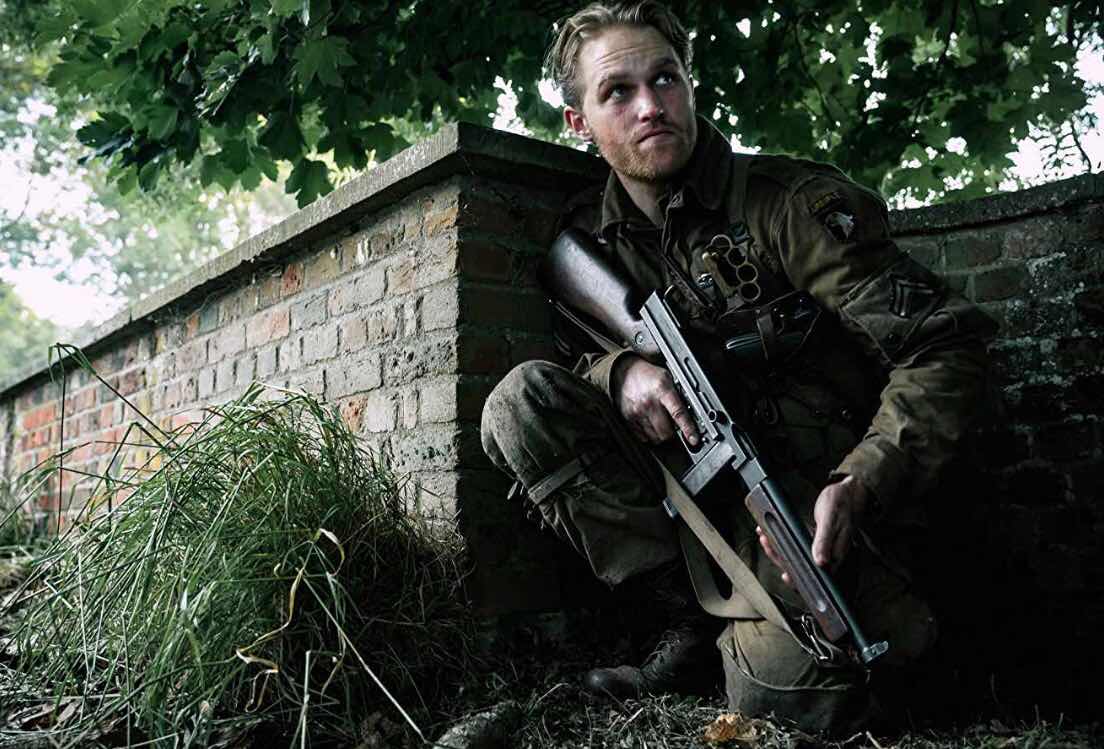
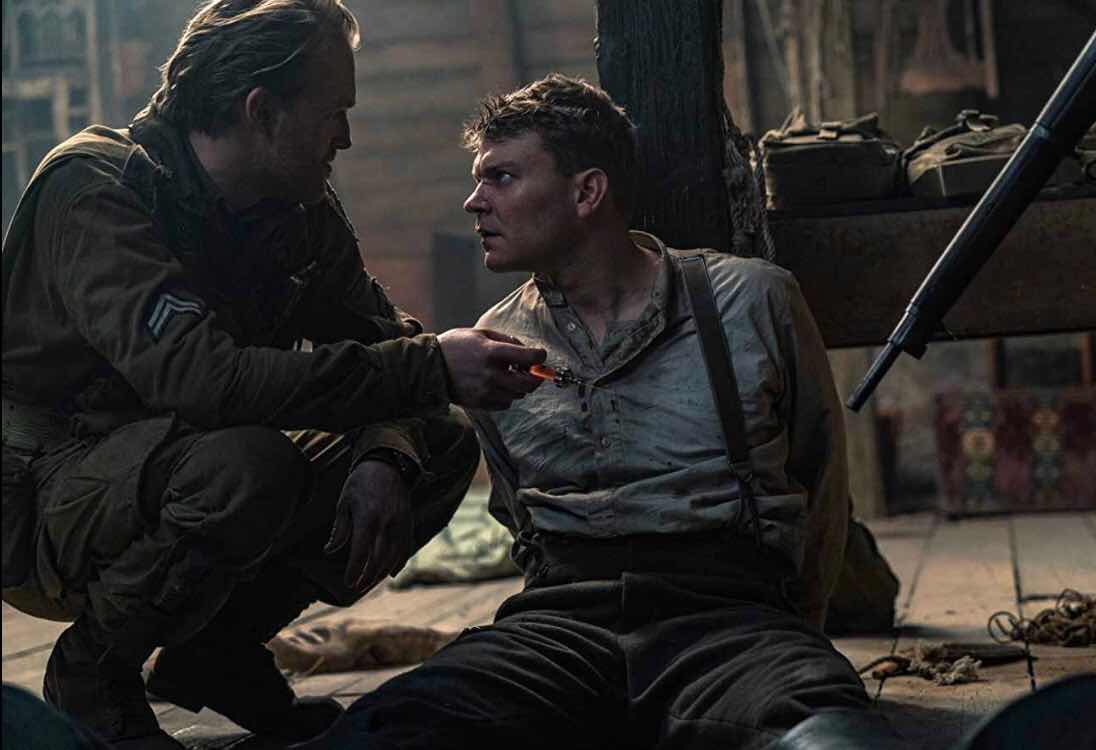
The survivors of the air drop include the fantastic Jovan Adepo, the audience surrogate who’s in nearly every scene of the film, and he just kills it. Then there’s this hard-edged Corporal leading the mission who I’d never seen before. My brain’s going, “This guy’s Snake Plissken!” The voice! The sneer! Then I see it’s Wyatt Russell (son of Kurt), who is just sensational here as the nails-hard explosives guy who’s seen it all and then some. I haven’t seen Lodge 49, but I just may have to, as Russell’s fantastic.


Their mission? Take out at heavily fortified Nazi transmission tower within the ruins of an old French church – and lemme tell ya, there is just every kind of awful going on behind those ancient stones, and our guys have to go in there. Overlord simply never lets up. The tension is incredibly well sustained, and there’s no sardonic self-aware winking at the audience – the actors take it deadly serious, and sell the hell out of the situation. Massive kudos to DPs Laurie Rose and Fabian Wagner, who along with Production Designer Jon Henson create a beautifully realistic and rich environment that’s utterly convincing and seeping with detail. The sound team also does amazing work here. Every Nazi bootstep echoes with malice – sound and score beautifully coexisting to deliciously mess with the audience – and those Nazis!  Pilou Asbæk (Games of Thrones’ Euron Greyjoy) is just oozing with dreadfulness as the SS officer running the show. This cast – including the great Bokeem Woodbine – is simply phenomenal. When the picture ended, I was ready to go right back and see it again. Director Avery channels Hellboy, Michael Mann’s The Keep – STILL not on blu-ray! Come on!– and Where Eagles Dare, to deliver a ridiculously satisfying thrillride that never lets up. If you’re a genre movie lover, you need to seek this sucker out immediately, before the holiday release deluge whisks it out of theaters – though they’d better bring a mop.


And if you’re a young kid in Wisconsin, maybe heading for your junior prom? Then you should definitely see this movie –  because Overlord will teach you one of the most enduring and important lessons you will ever learn: that Nazis are the most messed up, evil and deserving of hellfire bastards to ever walk the Earth. Overlord is very, very highly recommended.


Monday, November 12, 2018

BlacKkKlansman’s America First Infiltration


These days, reality has become so outlandish that it routinely mops the floor with fiction. Political America has transformed itself into one surreal Can You Top This? Hold My Beer, occurrence after another. It'd be laughable, if not for the increasing rise of violence and barely suppressed entitlement of outright racism.

Incredibly, BlacKkKlansman is based on a true story. In the early nineteen seventies, Ron Stallworth (John David Washington) finds himself the lone black detective on the Colorado Springs Police Department. Upon seeing a newspaper recruitment ad for the Ku Klux Klan, he impulsively calls the number and convinces the voice on the other end of the phone that he's a like-minded angry white man who's had it up to here with black people, and who's ready to do something about it.

A meeting is arranged - which Stallworth can't exactly attend himself. So he sends fellow detective Flip Zimmerman (The Last Jedi's Adam Driver) in his place - and infiltration begins. Washington (son of Denzel) is fantastic. Initially sent to keep tabs on a black student union event featuring former Black Panther Stokely Carmichael, Stallworth is supposed to just blend in and listen. But the civil rights movement can't help but make you question your place in the order of things - and Stallworth is a cop: "The Man," a "pig," - and Carmichael's renamed Kwame Ture (Corey Hawkins) speaks with passion and truth about the injustice in their lives that resonates loudly with Stallworth - as does college activist Patrice (Spider-Man: Homecoming's Laura Harrier).

Driver is outstanding, as a Jewish detective who's neglected his sense of cultural self, now pushing it down even further to avoid exposure by his new Klan buddies. Ryan Eggold is all managerial earnestness as the President of the local chapter of "the organization," who man-crushes hard on new recruit Driver - but his right-hand man has plenty of doubts. Jasper Pääkkönen (TV's Vikings) is phenomenal as one of the more luridly charismatic and hateful characters we're likely to see onscreen this year. Pääkkönen weaves jealousy and suspicion into a truly disturbing role. Nominate this guy, seriously!

BlacKkKlansman is Spike Lee's most outright entertaining film since Inside Man, but probably his most important film since Do the Right Thing. While evoking the Serpico 70s, Lee (with screenwriters Charlie Wachtel, David Rabinowitz and Kevin Willmott) bravely uses the film to draw a straight and bloody line back to our here and now, with strident echoes of the "Unite the Right" rally in Charlottesville. BlacKkKlansman is often hilarious, in an I, Tonya way, but the tone can whip unflinchingly into sickening portraits of unabashed racism and raw hatred that will turn your stomach. Hate inevitably leads to violence. Like Driver's character, the film may briefly convince you it's a wry comedy, but its agenda of social awareness and racial justice aims to infiltrate our sensibilities and when it finally emerges, the result is powerful and painful indeed. Easily one of the years best - and sadly, most necessary films. Not to be missed. 

Saturday, October 27, 2018

First Man’s Magnificent Desolation


The moon has forever looked down on humanity. Mythic, ghostly, impenetrable - it's always been there, and we've been forever drawn to it with a mixture of awe and fear. 

The mid-sixties was a time when science was determined to reach out and place a wedding band on the finger of exploration, and stride boldly into the future - and no figure embodied that most human of endeavors more than the astronaut. Today we almost take their achievements for granted. Sadly, in our current climate they've almost become an endangered species. But there was a time when launching someone into space captured the attention of the entire planet. What was that time like? Well if you're too young to remember, you don't need a time machine. As director Damien Chazelle's (Whiplash, La La Land) film about Neil Armstrong's journey from the early days of the Gemini program to being the first man to set foot on another world, is so jaw-droppingly realistic and authentic, it's like a window into another era. 

The opening minutes of First Man are as immersive and anxiety-inducing as anything I can remember experiencing, as Armstrong's test flight of the hypersonic X-15 experimental aircraft pushes out of the Earth's atmosphere, only to find he may not be able to get back down again. Chazelle grabs the audience by the lapels by vividly depicting the machinery of the day - all rivets and bolts, with incredibly sound design that envelops you in threatening rumbles and shuddering vibrations of groaning steel - of vehicles and occupants pushed beyond their designed limits of structural tolerance. 

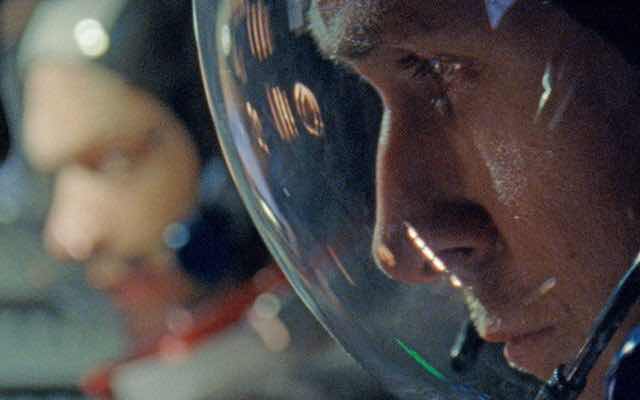
Neil Armstrong was an engineer and a civilian astronaut, and Ryan Gosling is simply phenomenal at evoking his cerebral problem-solving and calm under duress. It's a subtle, restrained performance loaded with emotion, barely held in check below the surface of his steady determination. The film moves back and forth between Armstrong and NASA's progress towards an actual lunar mission, and his home-life with wife Janet (The Crown's Claire Foy), a marriage haunted by unendurable loss. Foy is remarkable, and blows away any stereotypes of the long-suffering wife. First Man is a film about incredible pressures - both mechanical and emotional. The progress from Gemini to Apollo is full of tragic casualties. The shadow of dread and death is never far. Foy's fear that space is a mistress who's intent on forever snatching away her husband from their family is heartbreaking to watch. In both spaceflight and marriage, the feeling of enduring strain after strain is palpable.

Chazelle is only 33, but he's moved into the master class here. Scene after scene is conveyed with incredible immediacy of perspective. When the hatch closes on a capsule, sealing the occupants inside, the claustrophobia is tangible and right in your face. The use of sound is revolutionary. Straining components threaten to rip asunder, like a deep sea plunge out of Das Boot. It's stunning these scientists did what they did. The technology of the day seems impossibly analog, all dials and switches. Chazelle and cinematographer Linus Sandgren change formats as the eras evolve. Early scenes are shot in Super 16 mm, moving to 35 mm in the Gemini and Apollo sections, then popping into 65 mm crystalline detail on the lunar surface. 

This is stunning filmmaking, real cinema, and cries out to be seen in the theater - which may be a fleeting proposition. The human dynamics can feel bleak and restrained at times, and there's no overt heroics or showboating - that's not who Neil Armstrong was. As a result, audiences may be finding it challenging to connect with this story. The film's been failing at the box office in the wake of shockers like Venom and Halloween - which is a damn shame. They're missing out on one of the absolute best pictures in ages, and performances that deserve to be seen and celebrated. First Man is an incredible achievement and absolutely worth seeking out in theaters while you still can. Very highly recommended. 

Tuesday, October 2, 2018

A Twisted Twofer: Hereditary and Sacred Deer both punish parents

The horror genre is a beast of many stripes. Currently the roost is ruled by Blumhouse franchises like Paranormal Activity, The Purge, and Insidious, along with Poltergeist descendants in The Conjuring film series, such as The Nun. These films do incredibly well – Friday night date staples that deliver the thrills and jump-scares audiences hunger for.

But there’s another strain of horror that’s not nearly as date-night friendly, courtesy of entertainment company A24. These pictures are making names for their directors, and are definitely more disturbing. A24 has a strong indie sensibility that’s reaped plenty of critical attention, with films like Ex Machina, Lady Bird, Moonlight, Eighth Grade and Room. But they’re also fond of horror movies – unsettling, ‘effed-up horror movies – such as The Witchand the two movies we’re talking about today, both of which should come with a strong warning label.

First up, Hereditary, directed by Ari Aster, about a grieving family coming to terms with life after the death of the family matriarch. Toni Collette is the surviving daughter, and in a career of amazing performances, her work here is bold and unforgettable. As an audience member, if you’re coping with grief, or have strong feelings about being a parent, you might want to steer a really wide course away from this movie. Collette depicts grief at its most primal, naked and horrific. Her despair so raw that we come away wounded and bereft ourselves. Milly Shapiro, Gabriel Byrne and Alex Wolff round out this excellent cast. Aster evokes films such as Rosemary’s Baby, Don’t Look Now and The Wicker Man, delivering us a film worthy of their company, but incredibly hard to watch. 


If you’re feeling you still need one more sock in the jaw, there’s The Killing of a Sacred Deer. The title evokes a Greek tragedy, and director Yorgos Lanthimos (The Lobster) certainly brings a heavy sense of dread and portent to this story of a successful cardiologist’s (Colin Farrell) relationship with the son (Barry Keoghan) of a deceased patient. Lanthimos (with DP Thimios Bakatakis) overtly resurrects the chilly spirit of Stanley Kubrick, from fluid, dream-like tracking shots, to oddly stilted spousal conversations and moody violin-tortured Ligeti. Acts of violence are witnessed with a sudden, documentarian eye. Again, if you’re a parent, this one has a Proceed With Caution warning label. I’m still processing The Killing of a Sacred Deer. My initial reaction was to go take a good, cleansing shower. Farrell – along with Nicole Kidman – does great work, though the acting style here is very odd, with a kind of hushed theatricality, the purpose of which is hard to fathom.


I love horror in all its disturbing flavors and iterations, and the craft on display in both these films is undeniable. But my reaction to both of these was strong, to the point where I wanted to look away – and I think a lot of that’s due to being a parent. Both films treat children brutally, in ways it’s hard to shake or dismiss (“Oh, that’s just zombies,”). There’s a primeval terror when faced with the inability to protect your child or save them from doom, that both these films painfully evoke. I can’t say either film is one I’m looking to revisit anytime soon. They leave a depressing aftertaste that feels like existential nihilism. Though I’m pretty sure that there’s nothing Toni Collette can’t do. So as we say with many a twisted tale, “Proceed with Caution.”

Tuesday, September 25, 2018

Predator Shmedator


The perils of fandom – when you knowingly set off to see a movie, despite its 34% Tomatometer Score.

It’s been 31 years since we first heard “GET TO THE CHOPPAH!” and had our original encounter with the reptilian trophy hunter from outer space. Predator (directed by pre-Die Hard John McTiernan) became a fan favorite, right up there with Aliens – two Fox franchises that have since struggled mightily to serve up a worthy sequel. Getting Shane Black (Kiss Kiss Bang Bang, Iron Man 3) to helm a reimagining seemed like pop culture serendipity – he played one of the soldiers in the original, fer cryin’ out loud! Sense and sensibility.

So it’s a drag to report that suspicions confirmed – The Predator is pretty much a train wreck. What made the original such a gas was a combination of the pulp/gore plot and genre mash-up of war movie meets monster movie – plus a fantastic ensemble cast of scenery-chewers. Predator never stopped working the audience and was always fun. This iteration, not so much. 

Black clearly recognized the original’s Dirty Dozen ragtag miscreants were a huge part of its success – so he tries to create something similar here, with a busload of “Section 8” soldiers all discharged for psychiatric reasons, who’ve dubbed themselves “The Loonies.” Sniper protagonist Quinn McKenna (Boyd Holbrook) gets tossed into their company, right as one of the interstellar insurgents breaks loose, wreaking bloody havoc. Holbrook is serviceable, with a nice tough guy persona, but the rest of these guys – it’s like wondering into the world’s worst AA meeting that you can’t escape from. Black sets perceptions of mental illness back 30 years. The usually dependable Thomas Jane seems completely at sea depicting Tourette Syndrome. Game of Thrones’ Alfie Allen and Keegan-Michael Key don’t fare much better. Suddenly you find that Black’s fondness for drive-in B-grade hysterics has let him turn half The Predator’s screenplay into a horrific attempt at comedy. He seems to be trying to irreverently evoke the mindset of films made 30+ years ago, when political correctness took a backseat to firepower and gross-out humor. Friday the 13th meets Porky’s? That’s kind of where we’re at. Add the “Hot Scientist” character (Olivia Munn, proving all biologists must wear yoga pants), and you’re wincing for about two-thirds of the picture. Sterling K. Brown and Trevante Rhodes both do a lot with a little, easily the best actors in the film. Jake Busey is wasted in a criminally small part. Wish he’d had more to do!

McKenna has an estranged young son (Jacob Tremblay) who seems to be depicted as experiencing Autism – but Black tries to have it both ways, depicting a child with a disability, chastising one character for referring to him with the R-word…but then unable to resist using it yet again to squeeze out one more cheap laugh.

The twist here is that the Act 1 Predator is a fugitive – the real menace is a bigger, genetically-enhanced Assassin Predator, out to track down the first one, taking out anyone who gets in his way. There’s some pretty bad CGI happening in The Predator that rivals season 2 of Stranger Things. The Über Predator is cool and intimidating, but also often too-tall absurd. He’s also largely CG.

When The Predator isn’t making you cringe with its comedy misfires, it’s got you scratching your head with its chaotic, choppily cut action sequences. Cinematographer Larry Fong’s talents are woefully underutilized here, with no chance to deliver any of the iconic shots he’s capable of. Remember how people used to joke about how The Return of the King had like six endings? Well, The Predator is the drive-in equivalent, with yet another sequence of implausible demolition derby chaos following the last. It’s like being stuck in the Lincoln Tunnel.

I’ll always be fond of Predators, they’ve earned their place in the sci-fi bestiary of cool – and I’m a Shane Black fan. That’s what vexes me so much. Combining chocolate and peanut butter should taste great! So how come this outing makes me want to wash my mouth out?